Direct (AoIP Channel)
This differs from a Direct (AoIP Stream) port in that no Tx stream configuration is available. The port is only used for channel assignment and not for setting up a stream. Therefore, the AoIP Device Options window looks different:
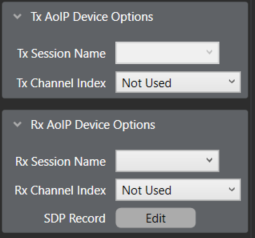
You can only select a predefined Tx Session (defined on a Direct (AoIP Stream) port) and channel.
The Rx configuration is the same.
For multichannel streams, the configuration would be to add a Direct (AoIP Stream) in the method described above, and to add the desired number of additional channels. For example, you can create a 4-channel stream (this is the maximum number of channels for a Tx stream):
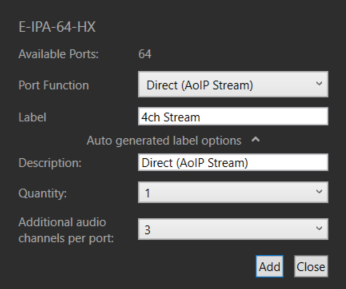
You now see that the Direct (AoIP Stream) is created with three Direct (AoIP Channels):
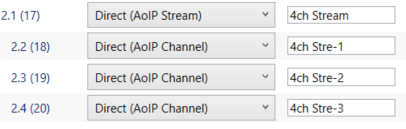
The indentation means that these channel ports are linked to the stream port.
This is seen explicitly in the channel port(s) properties under the option Parent Port:
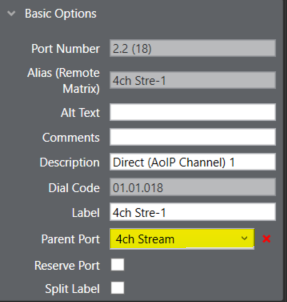
You can change the parent port after port creation, so that a stream channel count can be varied.
The channels made in this way are automatically assigned to the parent stream on the Tx side:
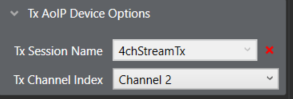
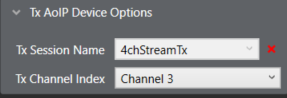
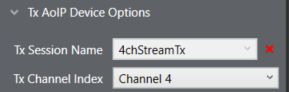
In the Direct (AoIP Stream) Tx SDP record you can see there are four channels:
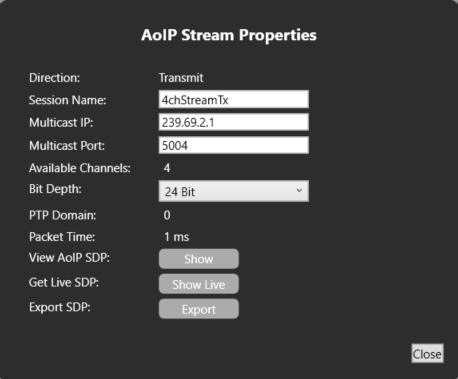
The receive side behaves similarly concerning multichannel streams. You can detect these in the same way as above.
To configure the Rx stream, you can choose where each channel is assigned in the port properties. For example, the incoming Dante stream now has four channels:
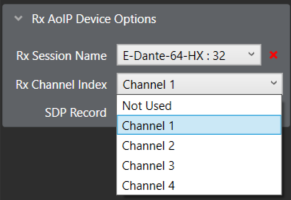
Now the drop-down list contains these four channels and you can assign one to each of our AoIP ports. Typically, you would mirror the configuration of the Tx side so that you map the following:
|
IPA Port |
Tx Stream |
Rx Stream |
|---|---|---|
|
Direct (AoIP Stream) |
Channel 1 |
Channel 1 |
|
Direct (AoIP Channel) |
Channel 2 |
Channel 2 |
|
Direct (AoIP Channel) |
Channel 3 |
Channel 3 |
|
Direct (AoIP Channel) |
Channel 4 |
Channel 4 |
You can receive a stream with up to eight channels. This can be split across 8 ports of either Direct (AoIP Stream) or Direct (AoIP Channel) as desired.
The key reason for bundling channels into multichannel streams rather than using single channel streams is to conserve the streams on the IPA (which might be used for any of the applications listed above) and bandwidth considerations. In general, Device A needs to transmit 16 channels to Device B, it is best practice to send 4 x 4-channel stream rather than 16 x 1 channel streams. Likewise, with receiving.